Commercial production
AI or CGI product film: which should you choose?
Compare generated visuals, controlled CGI and hybrid product films. Use a practical accuracy checklist to choose a workflow for your next brand advertisement.
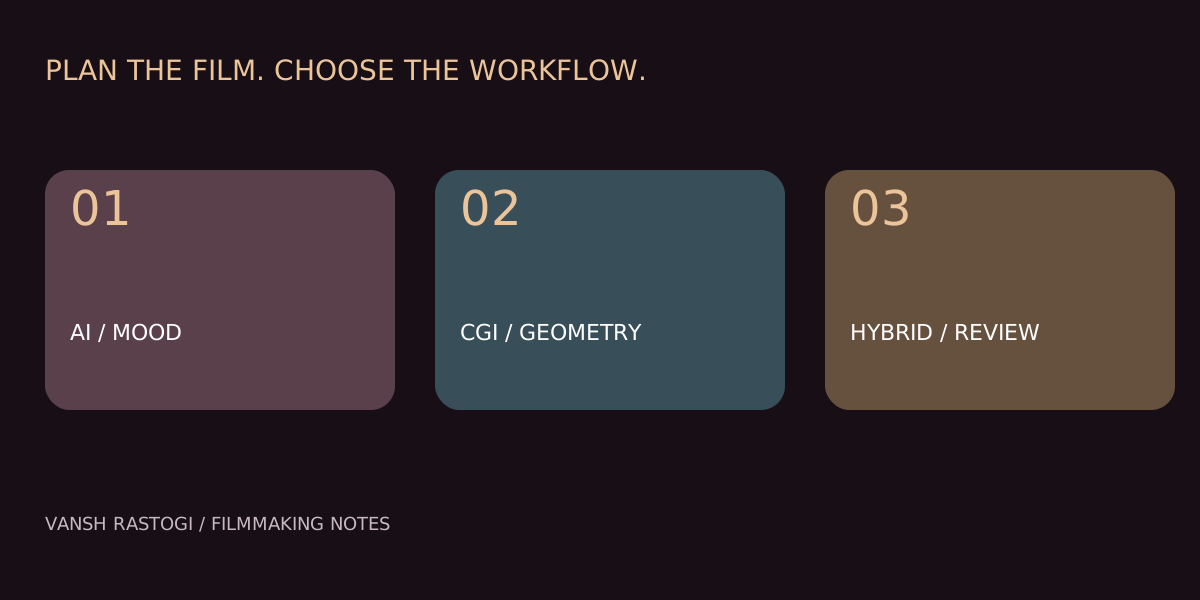
Choose the workflow around the detail that must remain correct. Generated visuals can help explore atmosphere and scenes; a controlled 3D workflow is useful when a product needs precise geometry, repeatable views or a specific mechanical action. A hybrid film can combine approved product assets with generated surroundings. None of these methods removes the need for review.
When is AI visual generation useful?
Consider it for early visual exploration, stylised environments and story concepts where atmosphere matters more than exact engineering. Begin with an approved reference and check every selected frame against it. A convincing still is not proof that the product stays consistent throughout a moving shot.
For an illustrative fragrance concept, a dramatic background and changing light might help communicate mood. The bottle silhouette, cap and label still need separate approval. An invented bottle in an educational illustration must not be presented as a manufactured product or an actual client commission.
When is controlled CGI a better fit?
A model-based workflow gives the team a defined object to light and animate. It is worth discussing for precise packshots, repeatable turntables, exploded views or demonstrations of a mechanism. Its usefulness depends on the accuracy of the model and source references, not simply on using the label CGI.
Ask whether a suitable model already exists, which materials need to be represented and whether dimensions are critical. An appearance-only concept may need different assets from a technical demonstration. A filmmaker should not invent hidden product construction to fill a gap in the brief.
What does a hybrid workflow look like?
One approach is to keep a verified product render or photographed packshot while developing backgrounds separately. Match light direction, perspective, shadows and reflections during compositing. Then judge the complete sequence, including transitions between methods. Mixing tools is useful only if the shots still belong to the same film.
- Exact pack and logo: preserve approved assets and inspect legibility.
- Mood exploration: compare several visual directions before animating.
- Mechanical explanation: work from verified product information and models.
- Human interaction: review anatomy, contact points and product scale.
- Multiple crops: plan what must remain visible in each delivery ratio.
How do you review product accuracy?
Use an approved reference beside the output. Check the silhouette, label wording, colour, proportions and quantity of components. Watch for changes during motion: a handle appearing, a cap bending or a logo morphing can undermine an otherwise polished image. Review at normal speed and inspect important transitions frame by frame.
Separate creative feedback from factual corrections. “Warmer light” is a direction choice. “The product has two handles, not one” is an accuracy requirement. Recording the difference helps avoid approving a beautiful shot that communicates the wrong product.
Is CGI always more expensive than AI?
There is no reliable universal rule. Existing assets, scene complexity, fidelity, revisions and finishing change the work involved. Compare quotes for the same deliverables and accuracy requirements. A low-cost test that needs extensive correction may be less practical than a more controlled starting point.
See the CGI and product films service for the scope of a conversation. Portfolio pieces marked as concepts are creative examples, not evidence of a commission, manufacturing specification or campaign outcome.
What should I send before requesting a product film?
Send product references, available 3D assets, approved artwork, the intended claim and the delivery formats. Identify what viewers must understand and what must never change. Use the AI ad briefing checklist to organise the commercial scope, and discuss your product film before choosing a workflow solely by a tool name.